
Sectors / Manufacturing / Glen Dimplex – Changeover Time Case Study
SMED Changeover Reduction: Glen Dimplex 87.66 min → faster
An injection moulding employee at Glen Dimplex Ireland used SMED (Single Minute Exchange of Dies) and 5 Whys root cause analysis to tackle the most time-consuming mould changeover in the factory — the 575 Tonne machine averaging 87.66 minutes per changeover. A Lean Practitioner case study in manufacturing changeover reduction.
Manufacturing / Heating & Electrical
Lean Practitioner
Ireland
87.66 min
Average changeover time (baseline)
5 Whys
Root cause analysis methodology used
SMED
Single Minute Exchange of Dies applied

Mould changeover on the 575T machine: 87.66 minutes and climbing
Glen Dimplex Ireland — one of the world’s largest electrical heating and renewables groups — manufactures electric stoves, fires and heating products. An employee in the Injection Moulding Department identified that the 575 Tonne machine had the most time-consuming changeover process of all 17 machines in the factory.
The changeover — swapping out the mould to produce different plastic parts — averaged 87.66 minutes (5,260 seconds). The delays were caused by:
- Slow fitting of water cooling pipes to the mould
- Time-consuming fitting of the secondary ejector system
- Mould design and lifting strap making physical handling difficult
- No thought had previously been given to modifying the attachments to speed up the process
Reducing changeover time would increase machine capacity, make the company more competitive, and enable greater production flexibility.
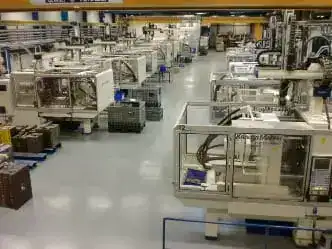
How SMED and 5 Whys tackled the factory's slowest changeover
Key Challenges
The injection moulding team needed to:
- Reduce changeover time significantly from the 87.66 minute baseline
- Address the water cooling pipe fitting process
- Simplify the secondary ejector system installation
- Modify the lifting strap and mould handling approach
- Increase machine capacity and production flexibility
The Lean Solution
The employee used SMED principles, 5 Whys root cause analysis, and a brainstorming event:
- Timed the changeover over several weeks and recorded averages on a Gantt Chart / Value Stream Map
- Applied 5 Whys to identify why the changeover took so long — reaching the root cause: no thought had been given to modifying the attachments
- Brainstormed improvements including: having replacement moulds ready at the machine, permanently fixing water pipes to moulds, carrying out colour changes during mould change, and modifying the lifting strap and ejector system
- Applied SMED principles — separating internal and external elements, converting internal to external where possible
“We, at Glen Dimplex Ireland, are performance driven, dedicated and experienced in the business.”
— Glen Dimplex Ireland
Lean 8-Step Problem-Solving Process applied to changeover reduction
The 5 Whys analysis was particularly revealing — it showed that the root cause wasn’t technical complexity but simply that nobody had previously considered modifying the changeover process.
Problem
575T machine has the longest changeover of all 17 machines. Average 87.66 minutes. Water pipes, ejector system and lifting strap cause delays.
Current State
Timed changeover over multiple weeks. 5,260 seconds average. Recorded on Gantt Chart / Value Stream Map. Largest moulds in the factory.
Target
Significantly reduce changeover time. Increase machine capacity. Enable greater production flexibility and competitiveness.
Root Cause
5 Whys: no thought given to modifying attachments. Water pipes refitted every time. Ejector system installation not optimised. Lifting strap design poor.
Countermeasures
SMED applied. Mould ready at machine before changeover. Water pipes permanently fixed. Colour change during mould change. Lifting strap modified.
Implementation
Changes implemented on the 575T machine. Changeover process redesigned separating internal and external elements.
Evaluation
Changeover time reduced. Machine capacity increased. Considering rollout of SMED approach to other machines.
Standardisation
New changeover procedure documented. SMED principles available for application across all 17 machines in the department.
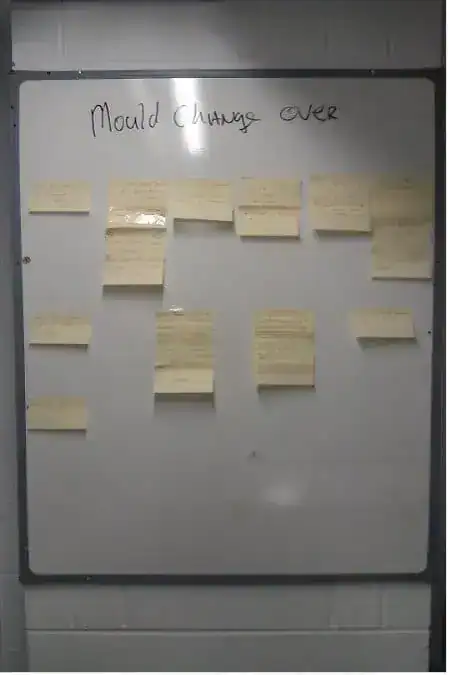
SMED results: changeover time reduced on the 575T injection moulder
The SMED implementation delivered measurable improvements:
- Changeover time reduced from the 87.66 minute baseline. By permanently fixing water pipes, modifying the ejector system, and having moulds ready at the machine, the team eliminated significant chunks of internal changeover time.
- Machine capacity increased. Less time changing over means more time producing — directly increasing the output potential of the most capable machine in the factory.
- SMED methodology proven. The successful application on the most challenging machine creates a blueprint for applying the same approach across all 17 machines.
- 5 Whys revealed the real barrier. The root cause wasn’t technical difficulty — it was simply that nobody had questioned the existing process. A cultural shift as much as a technical one.
Learnings
- The 5 Whys technique revealed that the root cause was lack of vision, not technical impossibility — the changeover process had never been questioned.
- SMED’s separation of internal and external elements is transformative — doing preparation work while the machine is still running eliminates dead time.
- Starting with the most difficult machine (575T) was strategically smart — if SMED works here, it works everywhere.
- Permanently fixing water pipes to moulds was a simple engineering change with a disproportionate impact on changeover time.
SMED in injection moulding: question the changeover before speeding it up
The 5 Whys analysis on this project reached a powerful conclusion: the reason changeovers took so long was simply that nobody had thought to modify them. That insight — that many industrial processes run slowly because they’ve never been questioned, not because they can’t be improved — is at the heart of Lean thinking.
LeanTeams has worked with Glen Dimplex on multiple improvement projects. You may also be interested in: Assembly Line and Design Projects.
Lean tools applied in this case study
Get results like Glen Dimplex
Our Lean training programmes help businesses across Ireland reduce waste, improve processes, and build a culture of continuous improvement.
More Case Studies
SMED and Lean Changeover Reduction for Manufacturing in Ireland
This case study demonstrates how 8-Step Problem Solving and SMED (Single Minute Exchange of Dies) principles can be applied to injection moulding changeover processes. Glen Dimplex Ireland used 5 Whys root cause analysis and structured brainstorming to identify and eliminate the barriers to fast changeovers on their largest machine.
LeanTeams provides practical Lean Practitioner training for manufacturers across Ireland — helping teams reduce changeover times, eliminate downtime, and increase machine capacity. We work across manufacturing, pharmaceutical, and retail sectors. This project is one of three Lean improvement projects at Glen Dimplex — see also Assembly Line (Kanban & 5S) and Design Projects (cross-departmental lead time reduction).
Explore all our case studies by sector or learn about our Lean training programmes including Lean Essentials, Enterprise Ireland LeanPlus, and our Lean Business Simulation.