
Sectors / Manufacturing / Glen Dimplex – Design Projects Case Study
Glen Dimplex: Design projects from 20 weeks to 12
An employee used Lean methodology to address the root causes of design project delays across R&D, Sales & Marketing and Group Design — targeting a 40% reduction in project lead time.
Manufacturing / Heating & Electrical
Lean Practitioner
Ireland
20 → 12 wks
Target: design project lead time reduction
3 depts
R&D, Sales & Marketing, Group Design aligned
40%
Target lead time reduction

Design projects averaging 20 weeks with no formal cross-departmental process
An employee identified that design projects — covering new electric stoves, inset fires, wall-mounted fires, product adjustments and furniture designs — were taking an average of 20 weeks to complete. These projects involved three departments: R&D, Sales & Marketing, and Group Design.
The root causes were structural:
- No formal process existed for managing projects across the three departments
- Projects often ran over their allowed time, delaying production
- Each team was not aware of the other teams’ timelines or constraints
- Poorly defined briefs led to many “turn backs” — work rejected and returned for revision
- The waste from unclear briefs, misaligned timelines, and rework was eroding the company’s ability to bring new products to market competitively
The target was to reduce project lead time from 20 weeks to 12 — a 40% reduction — by introducing a clear, defined process that would streamline cross-departmental collaboration.

Aligning three departments around a single project process
Key Challenges
The team needed to:
- Reduce design project lead time from 20 weeks to 12
- Create a formal cross-departmental project management process
- Ensure all three departments have visibility of each other’s timelines
- Improve brief quality to eliminate turn backs and rework
- Introduce project tracking and milestone management
The Lean Solution
Using the 8-Step methodology with a cross-departmental Kaizen event:
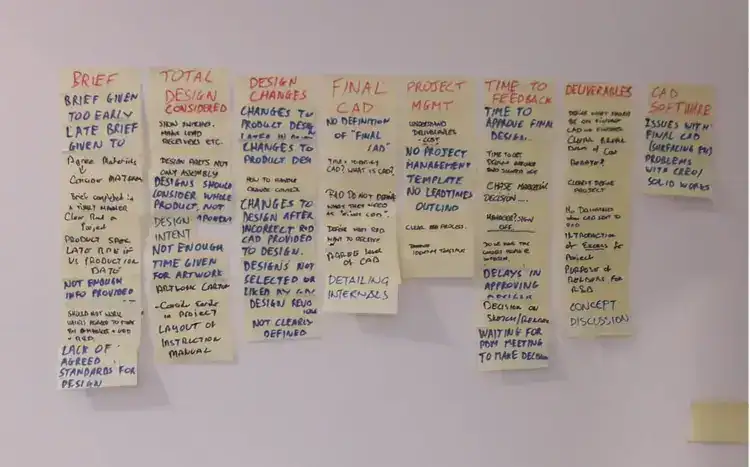
- Brought R&D, Sales & Marketing and Group Design together for a structured brainstorming session
- Each team identified issues on post-its through silent sharing — then R&D transcribed all ideas into a single view
- Grouped problems and prioritised using Impact/Ease assessment
- Created a project sheet standardising how projects are initiated, tracked and handed between departments
- Defined clear briefs with required information to prevent turn backs
- Established shared timelines and milestones visible to all three departments
“We, at Glen Dimplex Ireland, are performance driven, dedicated and experienced in the business.”
— Glen Dimplex Ireland
8-Step Problem-Solving Process
The Kaizen event was critical — it was the first time all three departments had sat together to discuss how their work interconnected. The silent sharing ensured every perspective was captured equally.
Problem
Design projects take 20 weeks average. No formal process across R&D, Sales & Marketing, Group Design. Poorly defined briefs cause rework.
Current State
Analysed project timelines. Found no shared process, no visibility across teams, frequent turn backs from unclear briefs.
Target
12-week lead time (40% reduction). Formal cross-departmental process. Clear briefs. Shared timeline visibility.
Root Cause
Kaizen event with all 3 departments: no formal process, teams unaware of others’ timelines, poor briefs, no project tracking.
Countermeasures
Project sheet created. Brief requirements standardised. Shared timelines established. Cross-departmental milestones defined.
Implementation
New project process rolled out across R&D, Sales & Marketing and Group Design. Project sheets in use for all new designs.
Evaluation
Project lead times improving toward 12-week target. Brief quality improved. Fewer turn backs. Better cross-departmental coordination.
Standardisation
Project management process documented. Standardised brief template in use. Applicable to all design project types.
Three departments, one process
The project created the cross-departmental infrastructure that had been missing:
- Standardised project sheet. Every design project now follows a consistent structure — from initiation through to completion — with clear handover points between departments.
- Improved brief quality. Standardised requirements mean designers receive complete, clear briefs — dramatically reducing turn backs and rework.
- Shared timeline visibility. R&D, Sales & Marketing and Group Design can all see each other’s timelines and milestones — preventing the “we didn’t know” delays.
- Lead time reduction on track. With the process infrastructure in place, projects are progressing toward the 12-week target — a 40% improvement over the 20-week average.
Learnings
- Cross-departmental Kaizen events are essential when the problem spans multiple teams — no single department could have solved this alone.
- Silent sharing ensured equal voice — in a session with R&D, Sales and Design, the loudest voice doesn’t dominate.
- The project sheet is a simple tool but creates enormous value by standardising what was previously ad-hoc.
- Clear briefs prevent more waste than any downstream process improvement — fixing the input fixes everything that follows.
Fix the handovers, fix the timeline
This project demonstrates that product development delays are often caused not by technical difficulty but by unclear processes between departments. When R&D, Sales & Marketing and Group Design have no shared language, no shared timeline, and no standardised brief — projects will overrun. The Lean methodology provided the structure to fix all three.
LeanTeams has worked with Glen Dimplex on multiple improvement projects. You may also be interested in: Changeover Time and Assembly Line.
Lean tools applied in this case study
Get results like Glen Dimplex
Our Lean training programmes help businesses across Ireland reduce waste, improve processes, and build a culture of continuous improvement.
More Case Studies
Explore our manufacturing case studies.