
Sectors / Performing Arts / Royal Opera House
Royal Opera House: Lean production efficiency for opera and ballet
LeanTeams partnered with the Royal Opera House Purfleet production facility to introduce Lean methods — Phase Planning, Kanban, Value Stream Mapping and 5S — across scenic design, construction and decoration. Targeting a 5–8% capacity increase for one of the world’s leading opera and ballet companies, without adding headcount.
Performing Arts / Scenic Production
Consultancy Project
Purfleet, London, UK
~5%
Expected capacity increase in 2025
+2–3%
Additional gains from Lean Daily Management
2024–25
Structured Lean transformation programme
Production bottlenecks at the Royal Opera House: scheduling, visibility and workflow
In early 2024, the Royal Opera House (ROH) invited LeanTeams to review its end-to-end production processes at the Purfleet facility — where scenic art, sets and stage pieces are designed, constructed and decorated for opera and ballet productions performed in their London theatre and venues around the world.
LeanTeams’ assessment surfaced several systemic issues limiting throughput and creating avoidable delays:
- No integrated production scheduling. Work was released to the shop floor based on drawing availability rather than an optimised build sequence — there was “limited evidence of a specific production scheduling process to optimise overall throughput times”
- Design capacity constraints. Design activities took 2–4 weeks per production but weren’t included in estimating or scheduling — creating bottlenecks, ad-hoc deployment and items being built “at the wrong time”
- Limited visibility of job status. No shared job-tracking system, causing tension between Construction and Scenic Art — especially when delays compressed decoration time
- Non-value-adding work. Value Stream Mapping revealed repeated assembly/disassembly of scenic pieces, inefficient metal spray finishing, and rework from gaps between Design & Drafting and Design for Production
- Underdeveloped Lean Daily Management. While pockets of Lean practice existed, the organisation lacked standardised daily team management, consistent 5S, standard work documentation, and routine continuous improvement habits
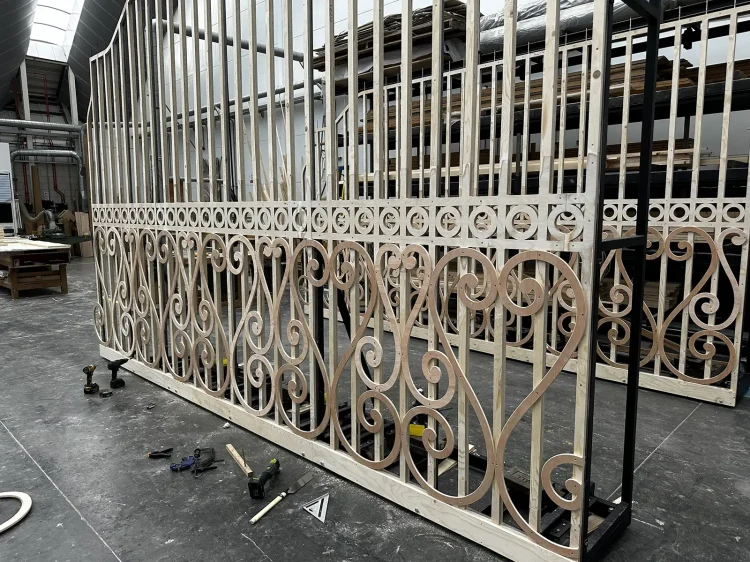
Last Planner, Kanban and VSM: Lean methods adapted for creative production
Key Challenges
The ROH Purfleet team needed to:
- Create an integrated production scheduling system that optimises throughput — not just releases work when drawings are ready
- Include design activities (2–4 weeks per production) in capacity planning and scheduling
- Give all departments real-time visibility of where every job sits in the pipeline
- Reduce non-value-adding work: repeated assembly/disassembly, inefficient finishing, design-production rework
- Build foundational Lean practices: daily management, 5S, standard work, continuous improvement routines
- Improve cross-team coordination between Construction and Scenic Art
The Lean Solution
LeanTeams supported ROH Purfleet throughout 2024 and 2025 with a structured, multi-strand approach tailored to a creative production environment:
- Last Planner System. Because the workflow resembled construction environments, LeanTeams introduced Last Planner practices — Phase Planning (1–3 month horizon), Weekly Work Planning, and visual management tools to align work with available capacity
- Kanban board for job tracking. A visual board tracking every item waiting and in current production — reducing cross-departmental friction and making status visible to everyone
- Design for Production capacity strengthening. Short-term capacity increases, better utilisation of design software (stress calculations, BOMs, cutting lists), and design libraries to reduce repetitive work
- Space planning and flow. Best practices from Scenic Art (weekly/daily space planning) transferred to Construction to reduce congestion and WIP accumulation
- Value Stream Mapping and targeted improvement projects. Current State VSM facilitated, identifying high-impact opportunities: reducing unnecessary assembly/disassembly, standardising metal spray finishing, improving the design-production interface
“LeanTeams’ engagement demonstrates how structured Lean methods — tailored to a creative production environment — can unlock meaningful improvements in flow, capacity, and cross-team collaboration.”
— Royal Opera House Purfleet engagement summary
Lean transformation approach for performing arts production
The engagement combined strategic planning tools (Last Planner, Phase Planning) with operational improvements (Kanban, VSM, 5S) — recognising that ROH Purfleet needed both better planning and better daily execution.
Assessment
LeanTeams reviewed end-to-end production across Design, Construction and Scenic Art. Identified scheduling, visibility, capacity and workflow issues.
Current State
Value Stream Mapped the full production flow. Found work released by drawing availability not build sequence. Design not in scheduling. No shared tracking.
Planning System
Introduced Last Planner: Phase Planning (1–3 months), Weekly Work Planning, visual management. Work aligned with capacity, not just drawing readiness.
Visibility
Kanban board deployed tracking every item across departments. Construction and Scenic Art now share a single view of production status.
Design Capacity
Short-term capacity increased. Software utilisation improved (stress calcs, BOMs, cutting lists). Design libraries reduce repetitive work.
Flow & Space
Scenic Art’s space planning practices transferred to Construction. Weekly and daily space allocation reduces congestion and WIP.
Targeted Projects
VSM identified: reduce assembly/disassembly cycles, standardise metal spray finishing, improve design-production interface. Labour hours freed.
Lean Foundation
Building daily management routines, 5S, standard work documentation. Expected to deliver additional 2–3% capacity improvement ongoing.
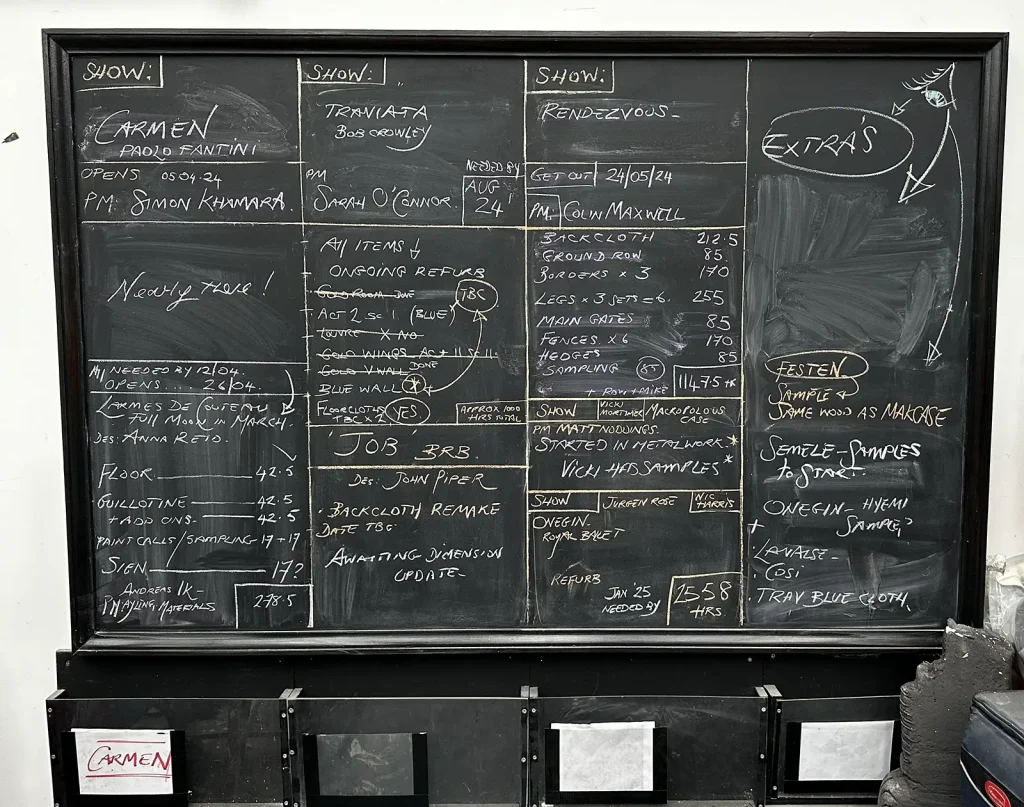
Results: capacity gains and Lean foundations at the Royal Opera House
The LeanTeams engagement has created both immediate results and a platform for ongoing improvement:
- ~5% capacity increase expected in 2025. Through Phase Planning, Kanban and improved design capacity — without adding headcount or extending hours.
- Additional 2–3% from Lean Daily Management. Embedding standardised daily practices, 5S and continuous improvement routines will deliver further gains in 2025 and beyond.
- Improved cross-team coordination. The new visual systems and planning routines have reduced friction between Construction and Scenic Art — and improved predictability of when scenic pieces will be ready for decoration.
- Reduced non-value-added work. Targeted projects addressing assembly/disassembly cycles and metal spray processes will free up significant labour hours for productive work.
- Stronger foundations. The organisation now has a shared planning system, better visibility of work, a clearer understanding of constraints, and a roadmap for future optimisation.
Learnings
- Lean methods work in creative production environments — the key is adapting the tools to the context. Last Planner (from construction Lean) was more appropriate than traditional manufacturing scheduling because ROH’s workflow is project-based and variable.
- Design capacity is a hidden bottleneck in creative production — when it’s not included in scheduling, it creates cascading delays that compress downstream work.
- Visual management (Kanban) reduces inter-departmental tension by replacing assumptions with shared facts. When everyone can see where every job is, blame is replaced by problem-solving.
- Best practices can be transferred between departments — Scenic Art’s space planning discipline was directly applicable to Construction.
- Value Stream Mapping reveals waste that’s invisible from within any single department — the repeated assembly/disassembly and design-production rework were systemic issues that no one team could see end-to-end.
- Building Lean Daily Management takes time but compounds — the 2–3% additional capacity gain from daily routines accumulates year on year.
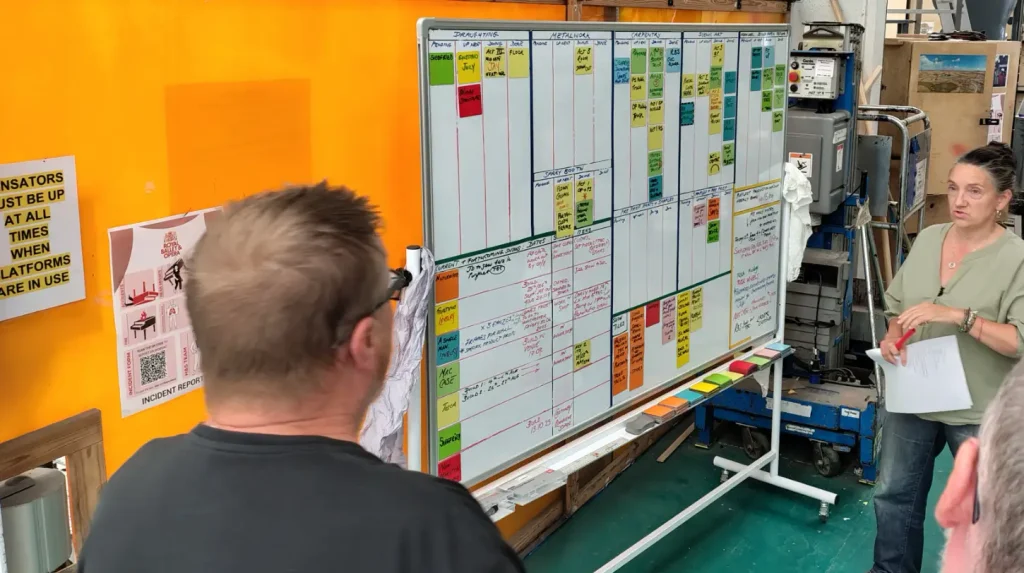
Lean for performing arts: world-class production behind world-class performances
The LeanTeams engagement at the Royal Opera House Purfleet demonstrates that structured Lean methods — when tailored to the context — unlock meaningful improvements in flow, capacity and cross-team collaboration, even in the most creative of environments.
By combining Phase Planning, Kanban, capacity strengthening and targeted process improvements, the Purfleet team is now positioned to deliver higher throughput, more predictable lead times, and a culture of continuous improvement — ensuring that world-class opera and ballet productions are supported by world-class production operations.
This case study sits within our Performing Arts & Culture sector. Explore all our case studies by sector or learn about our training programmes.
Lean methods adapted for performing arts production
Get results like the Royal Opera House
Our Lean training programmes help businesses across Ireland reduce waste, improve processes, and build a culture of continuous improvement.
More Case Studies
Lean for Performing Arts and Creative Production
This case study demonstrates that Lean methodology is not limited to manufacturing or services — it delivers measurable results in creative production environments including theatre, opera, ballet and live performance. The Royal Opera House engagement used Value Stream Mapping, Process Mapping, 5S, Kanban and Last Planner to address scheduling, visibility and workflow challenges.
LeanTeams works across manufacturing, pharmaceutical, financial services, professional services, retail, media & publishing and performing arts. Explore all our sector experience or learn about our Lean training programmes.