
NO TIME TO WASTE · ISSUE 30
7.5 Hours to 3: Streamlining Our Own Lean Administration
We teach Lean every week. We help clients map their processes, eliminate waste, and build standard work. But this month, we turned the lens on ourselves.
The administration of our Lean Practitioner programme — from initial enquiry through to certification — was consuming an estimated 7.5 hours per cohort. And most of it was invisible.
THE BIG IDEA
When Admin Becomes the Process You Never Mapped
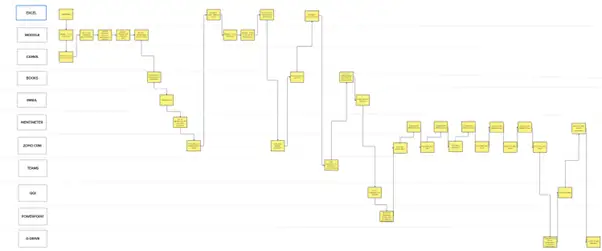
Our administration is split across five systems — our CRM (Zoho), our LMS, Email, Zoho Books (Finance) and Excel. Each system does its job. But we had never mapped the flow between them.
When we did, the picture was striking. Data was being entered more than once. Emails were being written where templates would do a better job. Steps that could be automated were being done manually — not because we chose to, but because the process had grown organically over time and nobody had stopped to look at it end to end.
This is the reality for most businesses. Administration processes rarely get the same attention as production or customer-facing work. They sit in the background, consuming hours that nobody measures — until someone maps them.
“If you can’t describe what you are doing as a process, you don’t know what you are doing.”
— W. Edwards Deming · (1900–1993)
So we applied the same tools we teach. We used Value Stream Mapping (VSM) to see where time was being consumed across the student journey — from enquiry to booking, registration, programme delivery, evaluation, and certification.
We clarified our master data (TPM) so that information flows cleanly between systems without re-keying. We’re building templates and standard work for repeatable steps. And we’re applying SMED thinking to reduce the changeover time between systems — the switching, logging in, copying, and pasting that adds up invisibly.
Our target is to reduce the 7.5 hours to around 3 hours per cohort. But the bigger goal is the student experience. We want every participant to have a seamless journey from the moment they enquire to the day they receive their certificate.
WHAT THE MAP REVEALED
Three things stood out when we mapped the process.
First, the handoffs. Information was moving between CRM, email, LMS, Books and Excel at multiple points — and each handoff involved manual re-entry. A student’s name, email, and programme details might be entered into three different systems separately. Every re-entry is a chance for error and a chunk of time.
Second, the lack of templates. Emails to students at each stage — confirmation, welcome, reminders, evaluation, certification — were being composed individually. The content was broadly the same each time, but there was no standard version. Building a library of standard templates with merge fields will eliminate this entirely.
Third, the invisible setup time. Switching between systems — opening the CRM, finding the record, then opening the LMS, then writing the email — was consuming more time than any single task. This is classic SMED territory: the changeover between activities is often longer than the activities themselves.
It’s a significant investment of time upfront to redesign these processes. But the aim is clear — deliver a top-class programme and experience as a result.
TRY THIS WEEK
Three Questions for Your Own Admin Processes
Time the handoffs. Not just the tasks — the switching between systems, the searching, the copy-and-paste. You may find the gaps between activities take longer than the activities themselves.
“Where there is no standard, there can be no improvement.”
— Taiichi Ohno · Father of the Toyota Production SystemAdministration is the process most businesses never map.
It sits quietly in the background, consuming hours that nobody counts.
But the same tools that transform a factory floor — VSM, standard work, SMED, master data discipline — work just as powerfully in an office, a CRM, or a spreadsheet.
If we’re asking our clients to do this, we should be doing it ourselves.
UPCOMING PROGRAMMES & EVENTS
New to Lean? Learn the principles and basic tools on our one day training experience. See how a process can be transformed with the application of Lean Thinking.
Apply Lean thinking in 12 weeks. Start with our Lean Business Simulation training held regularly in Dublin.
A full day of high-quality content, bookended by exclusive Lean Practice Days at Toyota UK’s Burnaston and Deeside plants. Learn and apply the Lean Transformation Framework (LTF) Diagnostic.
At LeanTeams, we help teams frame problems properly before they invest in solutions — through our Business Simulation and Lean Practitioner programmes.