
Sectors / Media & Publishing / Irish Examiner – Advertising System Case Study
The Irish Examiner: Automating ad production to eliminate waste
An employee in the Advertisement Production Department used 5S, TPM and automation to eliminate processing waste caused by a new advertising system — achieving significant savings through automated master ads and component processing.
Media / National Newspaper
Lean Practitioner
Cork, Ireland
Automated
Master ad and component processing
5S + TPM
Workplace organisation and asset care applied
Significant
Reduction in ad processing lead time

A new system that increased processing time instead of reducing it
When the Irish Examiner introduced a new advertising system, they discovered an unintended consequence: the processing time for content arriving via email increased significantly. Rather than making the department more efficient, the new system created additional waste in the ad production workflow.
The Advertisement Production Department is responsible for designing and producing all advertisements for the newspaper. The employee identified that:
- The new system had introduced additional processing steps for email-received content
- This represented substantial waste on labour and associated costs
- There was an opportunity to automate the master ads process
- Component processing could also be automated to eliminate manual handling
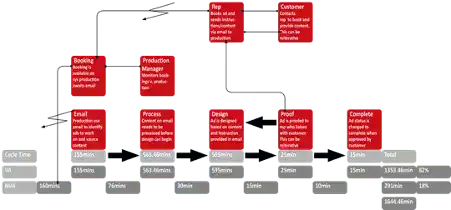
From increased processing time to automated production
Key Challenges
The ad production team needed to:
- Eliminate the processing time waste introduced by the new advertising system
- Reduce master ad processing time
- Automate component processing to remove manual steps
- Improve overall performance and throughput in the department
The Lean Solution
Using the 8-Step methodology with a Kaizen event, applying 5S and TPM principles:
- Brainstormed and evaluated all ideas within scope using silent sharing
- Prioritised using Impact/Ease chart
- Applied 5S Workplace Organisation — sorting, standardising and systematising the ad production environment
- Applied TPM (Total Productive Maintenance) / Asset Care — focusing on deterioration prevention rather than reactive fixes
- Automated the master ads process — eliminating manual processing of recurring ad templates
- Automated component processing — removing manual handling of ad elements received via email
“The Irish Examiner is a different and distinct voice in the national discourse, highlighting stories and perspectives not found elsewhere.”
— The Irish Examiner
8-Step Problem-Solving Process
The combination of 5S (physical workspace organisation) and TPM (system reliability) with process automation created a comprehensive solution — not just faster processing, but a more reliable and organised department.
Problem
New advertising system increased email content processing time. Substantial labour waste. Manual master ad processing. Manual component handling.
Current State
Measured processing times for ad content. Identified the additional steps introduced by the new system. Quantified labour waste.
Target
Eliminate processing waste. Automate master ads. Automate component processing. Improve department throughput.
Root Cause
Kaizen event: new system added manual steps for email content. No automation of recurring ads. No systematic workspace organisation.
Countermeasures
Master ads automated. Component processing automated. 5S applied to workspace. TPM/Asset Care principles implemented.
Implementation
Automation deployed. 5S implemented in ad production area. Asset care protocols established. Staff identified need for additional training.
Evaluation
Significant savings through automation. Lead time reduced. No additional resources required. Management confirmed efficiency gains.
Standardisation
Automated processes documented. 5S standards maintained. TPM protocols in place. Staff training ongoing.

Automation delivered savings without additional resources
The combination of automation and Lean workplace tools delivered clear results:
- Master ad processing automated. Recurring advertisement templates are now processed automatically — eliminating manual setup for each instance.
- Component processing automated. Ad elements received via email are now handled systematically rather than manually — removing the waste introduced by the new system.
- Significant savings confirmed. Data indicated measurable savings through the automation, with management confirming no additional resources were required.
- Significant reduction in lead time. The team achieved a measurable reduction in the time from ad content receipt to production-ready output.
- 5S and TPM foundations laid. The workplace organisation and asset care protocols create the basis for ongoing improvement in the department.
Learnings
- New systems don’t always improve efficiency — sometimes they introduce new waste. The Lean approach of measuring before and after revealed this clearly.
- Automation of repetitive processes (master ads, component handling) delivers disproportionate savings in a high-volume environment like daily newspaper production.
- 5S and TPM complement automation — organised workspaces and reliable systems ensure the automated processes run smoothly.
- Additional training was identified as a need — the team recognised that technical capability needed to keep pace with process changes.
When a new system creates new waste, Lean fixes both
This project is a useful reminder that technology alone doesn’t solve process problems — and can sometimes create new ones. The advertising system was introduced to improve efficiency, but actually increased processing time. The Lean approach of measuring, brainstorming, and implementing targeted countermeasures (automation, 5S, TPM) addressed both the original problem and the new waste the system had introduced.
LeanTeams has worked with The Irish Examiner on multiple improvement projects. You may also be interested in: Lost Production Time and Purchase Order System.
Lean tools applied in this case study
Get results like The Irish Examiner
Our Lean training programmes help businesses across Ireland reduce waste, improve processes, and build a culture of continuous improvement.
More Case Studies
Explore our media & publishing sector page.